Tuesday, December 28, 2010

DH Tea Leaves

From reading my (possibly) representative sample of DH proposals, I'd say the main theme of the conference will not be "Big Tent Digital Humanities" but "data integration". Of the 8 proposals I read, more than half of them were concerned with problems of connecting data across projects, disciplines, and different systems. My proposal was too (making 9), so perhaps I did have a representative sample.

Data integration is a meaty problem, resistant to generalized solutions. To my mind the answers, such as they are, will rely on the same set of practices that good data curation techniques use: open formats and open source code, and good documentation that covers the "why" of decisions made for projects as well as the "how." Data integration is a process that involves gaining an understanding of the sources and the semantics of their structures before you can connect them together. So, while there are tools out there that can enable successful data integration, there are (as usual) no silver bullets. Grasping the meanings and assumptions embodied in each project's data structures has to be the first step and this is only possible when those structures have been explained.

Sunday, December 05, 2010

That Bug Bit Me

"I had this problem and I fixed it" stories are boring to anyone except those intimately concerned with the problem, so I'm not going to tell that story. Instead, I'm going to talk about projects in the Digital Humanities that rely on 3rd party software, and talk about the value of expertise in programming and software architecture. From the outside, modern software development can look like building a castle out of Lego pieces: you take existing components and pop them together. Need search? Grab Apache Solr and plug it in. Need a data store? Grab a (No)SQL database and put your data in it. Need to do web development fast? Grab a framework, like Rails or Django. Doesn't sound that hard.

This is, more or less, what papyri.info looks like internally. There's a Solr install that handles search, a Mulgara triple store that keeps track of document relationships, small bits of code that handle populating the former two and displaying the web interface, and a JRuby on Rails application that provides crowdsourced editing capabilities.

Upgrading components in this architecture should range from trivially easy, to moderately complex (that's only if some interface has changed between versions, for example).

So why did I find myself sitting in a hotel lobby in Rome a few weeks ago having to roll back an to an older version of Mulgara so the editor application would work for a presentation the next day? A bunch of our queries had stopped working, meaning the editor couldn't load texts to edit. Oops.

And why did I spend the last week fighting to keep the application standing up after a new release of the editor was deployed?

The answer to both questions was that our Lego blocks didn't function the way they were supposed to. They aren't Lego blocks after all—they're complex pieces of software that may have bugs. The fact that our components are open source, and have responsive developers behind them is a help, but we can't necessarily expect those developers to jump to solve our problems. After all, the project's tests must have passed in order for the new release to be pushed, and unless there's a chorus of complaint, our problem isn't necessarily going to be high on their list of things to fix.

No, the whole point of using open source components is that you don't have to depend solely on other people to fix your problems. In the case of Mulgara, I was able to track down and fix the bug myself, with some pointers from the lead developer. The fix (or a better version of it) will go into the next release, and meantime we can use my patched version. In the case of the Rails issue, there seems to be a bug in the ActiveSupport file caching under JRuby that causes it to go nuts: the request never returns and something continually creates resources that have to be garbage collected. The symptom I was seeing was constant GC and a gradual ramping up of the CPU usage to the point where the app became unstable. Tracing back from that symptom took a lot of work, but once I identified it, we were able to switch away from file store caching, and so far things look good.

My takeaway from this is that even when you're constructing your application from prebuilt blocks, it really helps to have the expertise to dig into the architecture of the blocks themselves. Software components aren't Lego blocks, and although you'll want to use them (because you don't have the time or money to write your own search engine from scratch) you do need to be able to understand them in a pinch. It also really pays to work with open source components. I didn't have to spend weeks feeding bug reports to a vendor to help them fix our Mulgara problem. A handful of emails and a about a day's worth of work (spread over the course of a week) were enough to get me to the source of the problem and a fix for it (a 1-liner, incidentally).

Monday, May 10, 2010

#alt-ac Careers: Digital Humanities Developer

(part 1 of a series)

I've been a digital humanities developer, that is, someone who writes code, does interface and system design, and rescues data from archaic formats in support of DH projects in a few contexts during the course of my career. I'll be writing a piece for Bethany Nowviskie's #alt-ac (http://nowviskie.org/2010/alt-ac/) volume this year. This is (mostly) not that piece, though portions of it may appear there, so it's maybe part of a draft. This is an attempt to dredge up bits of my perspective as someone who has had an alternate-academic career (on and off) for the last decade. It's fairly narrowly aimed at people like me, who've done advanced graduate work in the Humanities, have an interest in Digital Humanities, and who have or are thinking about jobs that employ their technical skills instead of pursuing a traditional academic career.

A couple of future installments I have in mind are "What Skills Does a DH Developer Need?" and "What's Up with Digital Classics?"

In this installment, I'm going to talk about some of the environments I've worked in. I'm not going to pull punches, and this might get me into trouble, but I think that if there is to be a future for people like me, these things deserve an airing. If your institution is more enlightened than what I describe, please accept my congratulations and don't take offense.

Working for Libraries


In general, libraries are a really good place to work as a programmer, especially doing DH projects. I've spent the last three years working in digital library programming groups. There are some downsides to be aware of: Libraries are very hierarchical organizations, and if you are not a librarian then you are probably in a lower "caste". You will likely not get consistent (or perhaps any) support for professional development, conference attendance, etc. Librarians, as faculty, have professional development requirements as part of their jobs. You, whose professional development is not mandated by the organization (merely something you have to do if you want to stay current and advance your career), will not get the same level of support and probably won't get any credit for publishing articles, giving papers, etc. This is infuriating, and in my opinion self-defeating on the part of the institution, but it is an unfortunate fact.

[Note: Bethany Nowviskie informs me that this is not the case at UVA, where librarians and staff are funded at the same level for professional development. I hope that signals a trend. And by the way, I do realize I'm being inflammatory, talking of castes. This should make you uncomfortable.]

Another downside is that as a member of a lower caste, you may not be able to initiate projects on your own. At many insitutions, only faculty (including librarians) and higher level administrators can make grant proposals, so if you come up with a grant-worthy project idea, someone will have to front for you (and get the credit).

There do exist librarian/developer jobs, and this would be a substantially better situation from a professional standpoint, but since librarian jobs typically require a Master's degree in Library and/or Information Science, libraries may make the calculation that they would be excluding perfectly good programmers from the job pool by putting that sort of requirement in. These are not terribly onerous programs on the whole, should you want to get an MLIS degree, but it does mean obtaining another credential. For what it's worth, I have one, but have never held a librarian position.

It's not all bad though: you will typically have a lot of freedom, loose deadlines, shorter than average work-weeks, and the opportunity to apply your skills to really interesting and hard problems. If you want to continue to pursue your academic interests however, you'll be doing it as a hobby. They don't want your research agenda unless you're a librarian. In a lot of ways, being a DH developer in a library is a DH developer's nirvana. I rant because it's so close to ideal.

Working for a .edu IT Organization


My first full time, permanent position post-Ph.D. was working for an IT organization that supports the College of Arts and Sciences at UNC Chapel Hill. I was one of a handful of programmers who did various kinds of administrative and faculty project support. It was a really good environment to work in. I got to try out new technologies, learned Java, really understood XSLT for the first time, got good at web development and had a lot of fun. I also learned to fear unfunded mandates, that projects without institutional support are doomed, and that if you're the last line of support for a web application, you'd better get good at making it scale.

IT organizations typically pay a bit better than, say, libraries and since it's an IT organization they actually understand technology and what it takes to build systems. There's less sense of being the odd man out in the organization. That said, if you're the academic/DH applications developer it's really easy to get overextended, and I did a bad job of avoiding that fate, "learning by suffering" as Aeschylus said.

Working in Industry


Working outside academia as a developer is a whole other world. Again, DH work is likely to have to be a hobby, but depending on where you work, it may be a relevant hobby. You will be paid (much) more, will probably have a budget for professional development, and may be able to use it for things such as attending DH conferences. Downsides are that you'll probably work longer hours and you'll have less freedom to choose what you do and how you do it, because you're working for an organization that has to make money. The capitalist imperative may strike you as distasteful if you've spent years in academia, but in fact it can be a wonderful feedback mechanism. Doing things the right way (in general) makes the organization money, and doing them wrong (again, in general) doesn't. It can make decision-making wonderfully straightforward. Companies, particularly small ones, can make decisions with a speed that seems bewilderingly quick when compared to libraries, which thrive on committees and meetings and change direction with all the flexibility of a supertanker.

Another advantage of working in industry is that you are more likely to be part of a team working on the same stuff as you. In DH we tend to only be able to assign one or two developers to a job. You will likely be the lone wolf on a project at some point in your career. Companies have money, and they want to get stuff done, so they hire teams of developers. Being on a team like this is nice, and I often miss it.

There are lots of companies that work in areas you may be interested in as someone with a DH background, including the semantic web, text mining, linked data, and digital publishing. In my opinion, working on DH projects is great preparation for a career outside academia.

Funding


As a DH developer, you will more likely than not end up working on grant-funded projects, where your salary is paid with "soft money". What this means in practical terms is that your funding will expire at a certain date. This can be good. It's not uncommon for programmers to change jobs every couple of years anyway, so a time-limited position gives you a free pass at job-switching without being accused of job-hopping. If you work for an organization that's good at attracting funding, then it's quite possible to string projects together and/or combine them. Though there can be institutional impedance mismatch problems here, in that it might be hard to renew a time-limited position, or to convert it to a permanent job without re-opening it for new applicants, or to fill in the gaps between funding cycles. So some institutions have a hard time mapping funding streams onto people efficiently. These aren't too hard to spot because they go though "boom and bust" cycles, staffing up to meet demand and then losing everybody when the funding is gone. This doesn't mean "don't apply for this job," just do it with your eyes open. Don't go in with the expectation (or even much hope) that it will turn into a permanent position. Learn what you can and move on. The upside is that these are often great learning opportunities.

In sum, being a DH developer is very rewarding. But I'm not sure it's a stable career path in most cases, which is a shame for DH as a "discipline" if nothing else. It would be nice if there were more senior positions for DH "makers" as well as "thinkers" (not that those categories are mutually exclusive). I suspect that the institutions that have figured this out will win the lion's share of DH funding in the future, because their brain trusts will just get better and better. The ideal situation (and what you should look for when you're looking to settle down) is a place

  • that has a good track record of getting funded,

  • where developers are first-class members of the organization (i.e. have "researcher" or similar status),

  • where there's a team in place and it's not just you, and

  • where there's some evidence of long-range planning.


For the most part, though, DH development may be the kind of thing you do for a few years while you're young before you go and do something else. I often wonder whether my DH developer expiration date is approaching. Grant funding often won't pay enough for an experienced programmer, unless those who wrote the budget knew what they were doing [Note: I've read too many grant proposals where the developer salary is < $50K (entry-level) but they have the title "Lead Developer" vel sim.— for what it's worth, this positively screams "We don't know what we're doing!"]. It may soon be time to go back to working for lots more money in industry; or to try to get another administrative DH job. For now, I still have about a year's worth of grant funding left. Better get back to work.

Tuesday, May 04, 2010

Addenda et Corrigenda

The proceedings of the 2009 Lawrence J. Schoenberg Symposium on Manuscript Studies in the Digital Age, at which I was a panelist were recently published at http://repository.upenn.edu/ljsproceedings/. I contributed a short piece arguing for the open licensing of content related to the study of medieval manuscripts.

Peter Hirtle, Senior Policy Advisor at the Cornell University Library, wrote me a message commenting on the piece and raising a point that I had elided (reproduced with permission):

Dear Dr. Cayless:

I read with great interest your article on “Digitized Manuscripts and Open Licensing.” Your arguments in favor of a CC-BY license for medieval scholarship are unusual, important, and convincing.

I was troubled, however, to see your comments on reproductions of medieval manuscripts. For example, you note that if you use a CC-BY license, “an entrepreneur can print t-shirts using your digital photograph of a nice initial from a manuscript page.” Later you add:

"Should reproductions of cultural objects that have never been subject to copyright (and that would no longer be, even if they once had) themselves be subject to copyright? The fact is that they are, and some uses of the copyright on photographs may be laudable, for example a museum or library funding its ongoing maintenance costs by selling digital or physical images of objects in its collection, but the existence of such examples does not provide an answer to the question: as an individual copyright owner, do you wish to exert control how other people use a photograph of something hundreds or thousands or years old?"

There is a fundamental mistaken concept here. While some reproductions of cultural objects are subject to copyright, most aren’t. Ever since the Bridgeman decision, the law in the New York circuit at least (and we believe in most other US courts) is that a “slavish” reproduction does not have enough originality to warrant its own copyright protection. If it is an image of a three-dimensional object, there would be copyright, but if it is just a reproduction of a manuscript page, there would be no copyright. It may take great skill to reproduce well a medieval manuscript, but it does not take originality. To claim that it does encourages what has been labeled as “copyfraud.”

You can read more about Bridgeman on pps. 34-35 in my book on Copyright and Cultural Institutions: Guidelines for Digitization for U.S. Libraries, Archives, and Museums, available for sale from Amazon and as a free download from SSRN at http://papers.ssrn.com/sol3/papers.cfm?abstract_id=1495365.

Sincerely,
Peter Hirtle


Peter is quite right that the copyright situation in the US, at least insofar as faithful digital reproductions of manuscript pages are concerned, is (with high probability) governed by the 1999 Bridgeman vs. Corel decision. So it is arguably best practice for a scholar who has photographed manuscripts to publish them and assert that they are in the public domain.

I skimmed over this in my article because, for one thing, much of the scholarly content of the symposium dealt with European institutions and their online publication (some behind a paywall—sometimes a crazily expensive one) of manuscripts, so US copyright law doesn't necessarily pertain. For another, I had in mind not just manuscripts but inscriptions, to which—to the extent that they are three-dimensional objects—Bridgeman doesn't pertain. Finally, while it is common practice to produce faithful digital reproductions of manuscript texts, it is also common to enhance those images for the sake of readability, at which point they are (may be?) no longer "slavish reproductions" and thus subject to copyright. The problem of course, as so often in copyright, is that there's no case law to back this up. If I crank up the contrast or run a Photoshop (or Gimp) filter on an image, have I altered it sufficiently to make it copyrightable? I don't know for certain, and I'm not sure anyone does. So on balance I'd still argue for doing the simple thing and putting a Creative Commons license (CC-BY is my recommendation) on everything. This is what the Archimedes Palimpsest project does, for example, who are arguably in just this situation with their publication of multispectral imaging of the palimpsest. And they are to be commended for doing so.

Anyway, I'd like to thank Peter, first for reading my article and second for prodding me into usefully complicating something I had oversimplified for the sake of argument.

Tuesday, March 02, 2010

Making a new Numbers Server for papyri.info

[UPDATE: added relationships diagram]

One of the components of papyri.info (a fairly well-hidden one) is a service that provides lookups of identifiers and correlates them with related records in other collections. Over the last few weeks, I've been working on replacing the old, Lucene-based numbers server with a new, triplestore-based one. One of the problems with the old version (though not the one that initially sent me on this quest, which was that I hated its identifiers) was that its structure didn't match the multidimensional nature of the data.

Dimensions:

  • Collections in the PN (there are four, so far) are hierarchical: for the Duke Databank of Documentary Papyri (DDbDP) and the Heidelberger Gesamtverzeichnis der griechischen Papyrusurkunden Ägyptens (HGV—which has two collections, of metadata and translations), there are series, volumes, and items, and for the Advanced Papyrological Information System (APIS) there are institutions and items.
  • FRBR: there's a Work (the ancient document itself), which has expression in a scholarly publication, from which the DDbDP transcription, HGV records and translations, and APIS records and translations are derived; these may be made manifest in a variety of ways, including EpiDoc XML, an HTML view, etc. The scholarly work has bibliography, which is surfaced in the HGV records. There is the possibility of attaching bibliography at the volume level as well (since these are actual books, sitting in libraries). Libraries may have series-level catalog records too.
  • There are relationships between items that describe the same thing. DDbDP and HGV usually have a 1::1 relationship (but not always). APIS has some overlap with both.
  • There are internal relationships as well. HGV has the idea of a "principal edition," the canonical publication of a document (there are also "andere publikationen"—other publications). DDbDP does as well, but expresses it slightly differently: older versions that have been superseded have stub records with a pointer to the replacement. The replacements point backward as well, and these can form sometimes complex chains (imagine two fragments published separately, but later recognized as belonging to the same document and republished together).

Relationships:

All of this is really hard to represent in a relational or document-oriented fashion. It turns out though, that a graph database does really well. I experimented with Mulgara and found that it does the job perfectly. I can write SPARQL queries that retrieve the data I need from the point of view of any component. Then I can map these to nice URLs so that they are easy to retrieve, using a servlet that does some URL rewriting. Some examples:

An HGV record:
http://papyri.info/hgv/8875/rdf
An HGV translation:
http://papyri.info/hgvtrans/8875/rdf
An HGV record's principal edition and andere pub.:
http://papyri.info/hgv/249/frbr:Work/rdf
An APIS record:
http://papyri.info/apis/berenike.apis.17/rdf
A (corresponding) DDb record:
http://papyri.info/ddbdp/o.berenike;1;17/rdf
A DDb series listing (with "human-readable" citation):
http://papyri.info/ddbdp/chla/rdf
A DDb volume listing:
http://papyri.info/ddbdp/chla;1/rdf
The DDb collection listing:
http://papyri.info/ddbdp/rdf
The HGV collection listing:
http://papyri.info/hgv/rdf

Results are also available in Notation3 or JSON formats (available by substituting "n3" or "json" for "rdf" in the URLs above). All of this makes for a nice machine interface to the relationships between papyri.info data. One that can be generated purely from the data files themselves, plus an RDF file that contains the abbreviated series citations from which DDbDP derives its identifiers. The new Papyrological Editor that will allow scholars to propose emendations to existing documents and to add new ones will use it to determine what files to pull for editing. I also plan to drive the new Solr-based search indexing (which is necessarily document-oriented) using it, since it provides a clear view of which documents should be aggregated.

The URL schemes above illustrate what I plan to do with the new version of papyri.info. Content URLs will be of the form http://papyri.info/ <collection name> / <collection specific identifier> [/ <format>]. Leaving off a format will give you a standard HTML view of the document + associated documents; /source will give you the EpiDoc source document by itself; /atom will give you an ATOM-based representation. I'm also thinking of /rdfa for an HTML-based view of the numbers server data, with embedded RDFa.

What's Next

I haven't done anything really sophisticated with this yet. I'd like to experiment with extending the DCTERMS vocabulary to deal with (e.g.) typed identifiers. Importing other vocabularies (like FRBR or BIBO) may make sense as well. We're talking about hooking this up to bibliography (via records in Zotero) and ancient places (via Pleiades). It all works well with my design philosophy for papyri.info, which is that it should consist of data (in the form of EpiDoc source files and representations of those files), retrievable via sensible URLs, with modular services surrounding the data to make it discoverable and usable.

I made a couple of changes to Mulgara during the course of this:
  1. turned off its strange and repugnant habit of representing namespaces and other URIs by declaring them as entities in an internal DTD in returned RDF results. Please don't do this. It's 2010. For another thing it breaks if you have any URLEncoded characters (i.e. %something) in a URI, because your XML parser will think they are malformed parameter entities.
  2. made the servlet return a 404 not found for queries with no hits (which seems more RESTfully correct)
Anyway, I need to revisit the Mulgara changes I made and try to either get them committed to the Mulgara codebase, or refactor them so that I'm not actually messing with Mulgara's internals. I guess trying another triplestore is a third option. Mulgara is fast, easy to use, and it solved my problem, so I went with it. But there still might be better alternatives out there.

Thursday, December 31, 2009

#APA2010

In between shortening my lifespan by doing a crazy yardwork project this week, I've been following with interest the tweets from #MLA09. A couple of items of interest were that Digital Humanities has become an overnight success (only decades in the making), the job market (still) reeks, and there are serious inequities in the status of non-faculty collaborators in DH projects. None of this is new, of course, but it's good to see it so well stated in a highly-visible venue.

I'm more than ever convinced that, despite the occasional feelings of regret, I made the right decision to stop seeking faculty employment after I got my Ph.D. DH was not then, and perhaps still isn't now, a hot topic in Classics. It is odd, because some of the most innovative DH work comes out of Classics, but, as I've said on a number of occasions, DH pickup in the field is concentrated in a few folks who are 20 years ahead of everyone else. It's interesting to speculate why this may be so. Classics is hard: you have to master (at least) a couple of ancient languages (Latin, Greek at least), plus a couple of modern ones (French and German are the most likely suspects, but maybe Italian, Spanish, Modern Greek, etc. also, depending on your specialization), then a body of literature, history, and art before you can do serious work. Ph.D.s from other disciplines sometimes quail when I describe the comps we had to go through (2 3-hour translation exams, 2 4-hour written exams, and an oral—and that's before you got to do your proposal defense). It may be that there's no room for anything else in this mix, and it's something you have to add later on. Virtually all the "digital classicists" I know are either tenured or are not faculty (and aren't going to be—at least not in Classics). It's all a bit grim really. A decade ago, if you were a grad student in Classics with an interest in DH, you were doomed unless you were willing to suppress that interest until you had tenure. I don't know whether that's changed at all. I hope it has.

The good news, of course, is that digital skills are highly portable (and better-paid). The one on-campus interview I had (for which I wasn't offered the job) would have paid several thousand (for a tenure-track job!) less than the (academic!) programming job I ended up taking. And as fate would have it, I ended up doing digital classics anyway, at least until the grant money runs out.

So I wonder what the twitter traffic from APA10 will be like next week. Maybe DH will be the next big thing there too, but a scan of the program doesn't leave me optimistic.

Wednesday, December 16, 2009

Converting APIS

On Monday, I finished converting the APIS (Advanced Papyrological Information System) intake files to EpiDoc XML. I thought I'd write it up, since I tried some new things to do it. The APIS intake files employ a MARC-inspired text format that looks like:

cu001 | 1 | duke.apis.31254916
cu035 | 1 | (NcD)31254916
cu965 | 1 | APIS

status | 1 | 1
cu300 | 1 | 1 item : papyrus, two joining fragments mounted in
glass, incomplete ; 19 x 8 cm
cuDateSchema | 1 | b
cuDateType | 1 | o
cuDateRange | 1 | b
cuDateValue | 1 | 199
cuDateRange | 2 | e
cuDateSchema | 2 | b
cuDateType | 2 | o
cuDateValue | 2 | 100
cuLCODE | 1 | egy
cu090 | 1 | P.Duk.inv. 723 R
cu500 | 1 | Actual dimensions of item are 18.5 x 7.7 cm
cu500 | 2 | 12 lines
cu500 | 3 | Written along the fibers on the recto; written
across the fibers on the verso in a different hand and
inverse to the text on the recto
cu500 | 4 | P.Duk.inv. 723 R was formerly P.Duk.inv. MF79 69 R
cu510_m | 5 | http://scriptorium.lib.duke.edu/papyrus/records/723r.html
cu520 | 6 | Papyrus account of wheat from the Arsinoites (modern
name: Fayyum), Egypt. Mentions the bank of Pakrouris(?)
cu546 | 7 | In Demotic
cu655 | 1 | Documentary papyri Egypt Fayyum 332-30 B.C
cu655 | 2 | Accounts Egypt Fayyum 332-30 B.C
cu655 | 3 | Papyri

cu653 | 1 | Accounting -- Egypt -- Fayyum -- 332-30 B.C.
cu653 | 2 | Banks and banking -- Egypt -- Fayyum -- 332-30 B.C.
cu653 | 3 | Wheat -- Egypt -- Fayyum -- 332-30 B.C.
cu245ab | 1 | Account of wheat [2nd cent. B.C.]
cuPart_no | 1 | 1
cuPart_caption | 1 | Recto
cuPresentation_no | 1 | 1 | 1
cuPresentation_display_res | 1 | 1 | thumbnail
cuPresentation_url | 1 | 1 | http://scriptorium.lib.duke.edu/papyrus/images/thumbnails/723r-thumb.gif
cuPresentation_format | 1 | 1 | image/gif
cuPresentation_no | 1 | 2 | 2
cuPresentation_display_res | 1 | 2 | 72dpi
cuPresentation_url | 1 | 2 | http://scriptorium.lib.duke.edu/papyrus/images/72dpi/723r-at72.gif
cuPresentation_format | 1 | 2 | image/gif
cuPresentation_no | 1 | 3 | 3
cuPresentation_display_res | 1 | 3 | 150dpi
cuPresentation_url | 1 | 3 | http://scriptorium.lib.duke.edu/papyrus/images/150dpi/723r-at150.gif
cuPresentation_format | 1 | 3 | image/gif
perm_group | 1 | w

cu090_orgcode | 1 | NcD
cuOrgcode | 1 | NcD


Some of the element names come from, and have the semantics of MARC, while others don't. Fields are delimited with pipe characters '|' and are sometimes 3 columns, sometimes 4. The second column is meant to express order, e.g. cu500 (general note) 1, 2, 3, and 4. If there are 4 columns, the third is used to link related fields, e.g. an image with its label. The last column is the field data, which can wrap to multiple lines. This has to be converted to EpiDoc like:


<?xml version="1.0" encoding="UTF-8"?>
<TEI xmlns="http://www.tei-c.org/ns/1.0">
<teiHeader>
<fileDesc>
<titleStmt>
<title>Account of wheat [2nd cent. B.C.]</title>
</titleStmt>
<publicationStmt>
<authority>APIS</authority>
<idno type="apisid">duke.apis.31254916</idno>
<idno type="controlno">(NcD)31254916</idno>
</publicationStmt>
<sourceDesc>
<msDesc>
<msIdentifier>
<idno type="invno">P.Duk.inv. 723 R</idno>
</msIdentifier>
<msContents>
<summary>Papyrus account of wheat from the Arsinoites (modern name: Fayyum), Egypt.
Mentions the bank of Pakrouris(?)</summary>
<msItem>
<note type="general">Actual dimensions of item are 18.5 x 7.7 cm</note>
<note type="general">12 lines</note>
<note type="general">Written along the fibers on the recto; written across the fibers on
the verso in a different hand and inverse to the text on the recto</note>
<note type="general">P.Duk.inv. 723 R was formerly P.Duk.inv. MF79 69 R</note>
<textLang mainLang="egy">In Demotic</textLang>
</msItem>
</msContents>
<physDesc>
<p>1 item : papyrus, two joining fragments mounted in glass, incomplete ; 19 x 8 cm</p>
</physDesc>
<history>
<origin>
<origDate notBefore="-0199" notAfter="-0100"/>
</origin>
</history>
</msDesc>
</sourceDesc>
</fileDesc>
<profileDesc>
<langUsage>
<language ident="en">English</language>
<language ident="egy-Egyd">In Demotic</language>
</langUsage>
<textClass>
<keywords scheme="#apis">
<term>Accounting -- Egypt -- Fayyum -- 332-30 B.C.</term>
<term>Banks and banking -- Egypt -- Fayyum -- 332-30 B.C.</term>
<term>Wheat -- Egypt -- Fayyum -- 332-30 B.C.</term>
<term>
<rs type="genre_form">Documentary papyri Egypt Fayyum 332-30 B.C</rs>
</term>
<term>
<rs type="genre_form">Accounts Egypt Fayyum 332-30 B.C</rs>
</term>
<term>
<rs type="genre_form">Papyri</rs>
</term>
</keywords>
</textClass>
</profileDesc>
</teiHeader>
<text>
<body>
<div type="bibliography" subtype="citations">
<p>
<ref target="http://scriptorium.lib.duke.edu/papyrus/records/723r.html">Original record</ref>.</p>
</div>
<div type="figure">
<figure>
<head>Recto</head>
<figDesc> thumbnail</figDesc>
<graphic url="http://scriptorium.lib.duke.edu/papyrus/images/thumbnails/723r-thumb.gif"/>
</figure>
<figure>
<head>Recto</head>
<figDesc> 72dpi</figDesc>
<graphic url="http://scriptorium.lib.duke.edu/papyrus/images/72dpi/723r-at72.gif"/>
</figure>
<figure>
<head>Recto</head>
<figDesc> 150dpi</figDesc>
<graphic url="http://scriptorium.lib.duke.edu/papyrus/images/150dpi/723r-at150.gif"/>
</figure>
</div>
</body>
</text>
</TEI>


I started learning Clojure this summer. Clojure is a Lisp implementation on top of the Java Virtual Machine. So I thought I'd have a go at writing an APIS converter in it. The result is probably thoroughly un-idiomatic Clojure, but it converts the 30,000 plus APIS records to EpiDoc in about 2.5 minutes, so I'm fairly happy with it as a baby-step. The script works by reading the intake file line by line and issuing SAX events that are handled by a Saxon XSLT TRansformerHandler, which in turn converts to EpiDoc. So in effect, the intake file is treated as though it were an XML file and transformed with a stylesheet.

Most of the processing is done with three functions:

generate-xml takes a File, instantiates a transforming SAX handler from a pool of TransformerFactory objects, starts calling SAX events, and then hands off to the process-file function.


(defn generate-xml
[file-var]
(let [xslt (.poll @templates)
handler (.newTransformerHandler (TransformerFactoryImpl.) xslt)]
(try
(doto handler
(.setResult (StreamResult. (File. (.replace
(.replace (str file-var) "intake_files" "xml") ".if" ".xml"))))
(.startDocument)
(.startElement "" "apis" "apis" (AttributesImpl.)))
(process-file (read-file file-var) "" handler)
(doto handler
(.endElement "" "apis" "apis")
(.endDocument))
(catch Exception e
(.println *err* (str (.getMessage e) " processing file " file-var))))
(.add @templates xslt)))


process-file
recursively processes a sequence of lines from the file. If lines is empty, we're at the end of the file, and we can end the last element and exit, otherwise, it splits the current line on pipe characters, calls handle line, then calls itself on the remainder of the line sequence.


(defn process-file
[lines, elt-name, handler]
(if (empty? lines)
(.endElement handler "" elt-name elt-name)
(if (not (.startsWith (first lines) "#")) ; comments start with '#' and can be ignored
(let [line (.split (first lines) "\\s+\\|\\s+")
ename (if (.contains (first lines) "|") (aget line 0) elt-name)]
(handle-line line elt-name handler)
(process-file (rest lines) ename handler)))))


handle-line does most of the XML-producing work. The field name is emitted as an element, columns 2 (and 3 if it's a 4-column field) are emitted as @n and @m attributes, and the last column is emitted as character conthttp://www.blogger.com/img/blank.gifent. If the line is a continuation of the preceding line, then it will be emitted as character data.


(defn handle-line
[line, elt-name, handler]
(if (> (alength line) 2) ; lines < 2 columns long are either continuations or empty fields
(do (let [atts (AttributesImpl.)]
(doto atts
(.addAttribute "" "n" "n" "CDATA" (.trim (aget line 1))))
(if (> (alength line) 3)
(doto atts
(.addAttribute "" "m" "m" "CDATA" (.trim (aget line 2)))))
(if (false? (.equals elt-name ""))
(.endElement handler "" elt-name elt-name))
(.startElement handler "" (aget line 0) (aget line 0) atts))
(let [content (aget line (- (alength line) 1))]
(.characters handler (.toCharArray (.trim content)) 0 (.length (.trim content)))))
(do
(if (== (alength line) 1)
(.characters handler (.toCharArray (aget line 0)) 0 (.length (aget line 0)))))))


The -main function kicks everything off by calling init-templates to load up a ConcurrentLinkedQueue with new Template objects capable of generating an XSLT handler and then kicking off a thread pool and mapping the generate-xml function to a sequence of files with the ".if" suffix. -main takes 3 arguments, the directory to look for intake files in, the XSLT to use for transformation, and the number of worker threads to use. I've been kicking it off with 20 threads. Speed depends on how much work my machine (3 GHc Intel Core 2 Duo Macbook Pro) is doing at the moment, but is quite zippy.


(defn init-templates
[xslt, nthreads]
(dosync (ref-set templates (ConcurrentLinkedQueue.) ))
(dotimes [n nthreads]
(let [xsl-src (StreamSource. (FileInputStream. xslt))
configuration (Configuration.)
compiler-info (CompilerInfo.)]
(doto xsl-src
(.setSystemId xslt))
(doto compiler-info
(.setErrorListener (StandardErrorListener.))
(.setURIResolver (StandardURIResolver. configuration)))
(dosync (.add @templates (.newTemplates (TransformerFactoryImpl.) xsl-src compiler-info))))))

(defn -main
[dir-name, xsl, nthreads]
(def xslt xsl)
(def dirs (file-seq (File. dir-name)))
(init-templates xslt nthreads)
(let [pool (Executors/newFixedThreadPool nthreads)
tasks (map (fn [x]
(fn []
(generate-xml x)))
(filter #(.endsWith (.getName %) ".if") dirs))]
(doseq [future (.invokeAll pool tasks)]
(.get future))
(.shutdown pool)))


I had some conceptual difficulties figuring out how best to associate Templates with the threads that execute them. The easy thing to do would be to put the Template creation in the function that is mapped to the file sequence, but that bogs down fairly quickly, presumably because a new Template is being created for each file and memory usage balloons pretty quickly. So that doesn't work. In Java, I'd either a) write a custom thread that spun up its own Template or b) create a pool of Templates. After some messing around, I went with b) because I couldn't see how to do such an object-oriented thing in a functional way. b) was a bit hard too, because I couldn't see how to store Templates in a Clojure collection, access them, and use them without wrapping the whole process in a transaction, which seems like it would lock the collection much too much. So I used a threadsafe Java collection, ConcurrentLinkedQueue, which manages concurrent access to its members on its own.

I've no doubt there are better ways to do this, and I expect I'll learn them in time, but for now, I'm quite pleased with my first effort. Next step will probably be to add some Schematron validation for the APIS files. My impression of Clojure is that it's really powerful, and a good way to write concurrent programs. To do it really well, I think you'd need a fairly deep knowledge of both Lisp-style functional programming and the underlying Java/JVM aspects, but that seems doable.

Tuesday, October 27, 2009

Object Artefact Script

A couple of weeks ago, I attended a workshop at the Edinburgh eScience Institute on the relation of text in ancient (and other) documents to its context and on the problems of reading difficult texts on difficult objects and ways in which technology can aid the process of interpretation and dissemination without getting in the way of it. The meeting was well summarized by Alejandro Giacometti in his blog, and the presentations are posted on the eSI wiki.

Kathryn Piquette discussed what would be required to digitally represent Egyptian hieroglyphic texts without divorcing them from their contexts as an integral part of monumental architecture. For example, the interpretation of the meaning of texts should be able to take into account the times of day (and/or year) when they would have been able to be read, their relationship to their surroundings, and so on. The established epigraphical practice of divorcing the transcribed text from its context, while often necessary, does some violence to its meaning, and this must be recognized and accounted for. At the same time, digital 3D reconstructions are themselves an interpretation, and it is important to disclose the evidence on which that interpretation is based.

Ségolène Tarte talked about the process of scholarly interpretation in reading the Vindolanda tablets and similar texts. As part of analysing the scholarly reading process, the eSAD project observed two experts reading a previously-published tablet. During the course of their work, they came up with a new reading that completely changed their understanding of the text. The previous reading hinged on the identification of a single word, which led to the (mistaken) recognition of the document as recording the sale of an ox. The new reading hinged on the recognition of a particular letterform as an 'a'. The ways in which readings of difficult texts are produced—involving skipping around looking for recognizable pieces of text upon which (multiple) partial mental models of the texts are constructed, which must then be resolved somehow into a reading—means that an Interpretation Support System (such as the one eSAD proposes to develop) must be sensitive to the different ways of reading scholars use and must be careful not to impose "spurious exactitude" on them.

Dot Porter gave an overview of a variety of projects that focus on representing text, transcription, and annotation alongside one another as a way into discussing the relationship between digital text and physical text. She cautioned against attempts to digitally replicate the experience of the codex, since there is a great deal of (necessary) data interpolation that goes on in any detailed digital reconstruction, and this elides the physical reality of the text. Digital representations may improve (or even make possible) the reading of difficult texts, such as the Vindolanda tablets or the Archimedes Palimpsest, so for purposes of interpretation, they may be superior to the physical reality. They can combine data, metadata, and other contextual information in ways that help a reader to work with documents. But they cannot satisfactorily replicate the physicality of the document, and it may be a bit dishonest to try.

I talked about the img2xml project I'm working on with colleagues from UNC Chapel Hill. I've got a post or two about that in the pipeline, so I won't say much here. It involves the generation of SVG tracings of text in manuscript documents as a foundation for linking and annotation. Since the technique involves linking to an XML-based representation of the text, it may prove superior to methods that rely simply on pointing at pixel coordinates in images of text.

Ryan Bauman talked about the use of digital images as scholarly evidence. He gave a fascinating overview of sophisticated techniques for imaging very difficult documents (e.g. carbonized, rolled up scrolls from Herculaneum) and talked about the need for documentation of the techniques used in generating the images. This is especially important because the images produced will not resemble the way the document looks in visible light. Ryan also talked about the difficulties involved in linking views of the document that may have been produced at different times, when the document was in different states, or may have used different techniques. The Archimedes Palimpsest project is a good example of what's involved in referencing all of the images so that they can be linked to the transcription.

Finally, Leif Isaksen talked about how some of the techniques discussed in the earlier presentations might be used in crowdsourcing the gathering of data about inscriptions. Inscriptions (both published and unpublished) are frequently encountered (both in museums and out in the open) by tourists who may be curious about their meaning, but lack the ability to interpret them. They may well, however, have sophisticated tools available for image capture, geo-referencing, and internet access (via digital cameras, smartphones, etc.). Can they be employed, in exchange for information about the texts they encounter, as data gatherers?

Some themes that emerged from the discussion included:

  • the importance of communicating the processes involved in generating digital representations of texts and their contexts (i.e. showing your work)

  • the need for standard ways of linking together image and textual data

  • the importance of disseminating data and code, not just results


This was a terrific workshop, and I hope to see followup on it. ESAD is holding a workshop next month on "Understanding image-based evidence," that I'm sorry I can't attend and from which look forward to seeing the output.

Friday, October 16, 2009

Stomping on Innovation Killers

@foundhistory has a nice post on objections one might hear on a grant review panel that would unjustly torpedo an innovative proposal. I thought it might be a good idea to take a sideways look at these as advice to grant writers.

“

  • Haven’t X, Y, and Z already done this? We shouldn’t be supporting duplication of effort.

  • Are all of the stakeholders on board? (Hat tip to @patrickgmj for this gem.)

  • What about sustainability?


”

So, some ideas for countering these when you're working on your proposal:


  1. Have you looked at work that's been done in this area (this might entail some real digging)? If there are projects and/or literature that deal with the same areas as your proposal, then you should take them into account. You need to be able to show you've done your homework and that your project is different from what's come before.

  2. Who is your audience? Have you talked to them? If you can get letters of support from one or more of them, that will help silence the stakeholders objection.

  3. You ought to have some sort of story about sustainability and/or the future beyond the project, to show that you've thought about what comes next. Even if your project is an experiment, you should talk about how you're going to disseminate the results so that those who come after will be able to build on your work.


I agree with Tom that these criticisms can be deployed to stifle creative work. In technology, sometimes wheels need to be reinvented, sometimes the conventional wisdom is flat wrong, and sometimes worrying overmuch about the future paralyses you. But if you're writing a proposal, assume these objections will be thrown at it, and do some prior thinking so you can spike them before they kill your innovative idea.

Monday, August 10, 2009

Upgrade Notes

During my recent work on moving the Papyrological Navigator from Columbia to NYU, I ran into some issues that bear noting. It's a bit hard to know whether these are generalizable, but they seem to me to be good examples of the kinds of things that can happen when you're upgrading a complex system, and I don't want to forget about them.

Issue #1
Search results in the PN are supposed to return with KWIC snippets, highlighting the search terms. As part of the move, I upgraded Lucene to the latest release (2.4.1). The Lucene in the PN was 2.3.x, but the developer at Columbia had worked hard to eke as much indexing speed out of it as possible, and had imported code from the 2.4 branch, with some modifications. Since this code was really close to 2.4, I'd had reason to hope the upgrade would be smooth, and it mostly was. Highlighting wasn't working for Greek though, even though the search itself was...

Debugging this was really hard, because as it turned out, there was no failure in any of the running code. It just wasn't running the right code. A couple of the slightly modified Lucene classes in the PN codebase were being stepped on by the new Lucene because instead of a jar named "ddbdp.jar", the new PN jars were named after the project in which they resided (so, "pn-ddbdp-indexers.jar". And they were getting loaded after Lucene instead of before. Not the first time I'd seen this kind of problem, but always a bit baffling. In the end I moved the PN Lucene classes out of the way by changing their names and how they were called.

Issue #2

This one was utterly baffling as well. Lemmatized search (that is, searching for dictionary headwords and getting hits on all the forms of the word—very useful for inflected languages, like Greek) was working at Columbia, and not at NYU. Bizarre. I hadn't done anything to the code. Of course, it was my fault. It almost always is the programmer's fault. A few months before, in response to a bug report (and before I started working for NYU), I had updated the transcoder software (which converts between various encodings for Ancient Greek) to conform to the recommended practice for choosing which precomposed (letter + accent) character to use when the same one (e.g. alpha + acute accent) occurs in both the Greek (Modern) and Greek Extended (Ancient) blocks in Unicode. Best practice is to choose the character from the Greek block, so \u03AC instead of \u1F71 for ά. Transcoder used to use the Greek Extended character, but since late 2008 it has followed the new recommendation and used characters from the Greek block, where available. Unfortunately this change happened after transcoder had been used to build the lemma database that the PN uses to expand lemmatized queries. So it had the wrong characters in it, and a search for any lemma containing an acute accent would fail. Again, all the code was executing perfectly; some of the data was bad. It didn't help that when I pasted lemmas into Oxygen, it normalized the encoding, or I might have realized sooner that there were differences.

Issue #3

Last, but not least, was a bug which manifested as a failure in certain types of search. "A followed by B within n places" searches worked, but "A and B (not in order) within n places" and "A but not B within n places" both failed. Again, no apparent errors in the PN code. The NullPointerException that was being thrown came from within the Lucene code! After a lot of messing about, I was able to determine that the failure was due to a Lucene change that the PN code wasn't implementing against. Once I'd found that, all it took to fix it was to override a method from the Lucene code. This was actually a Lucene bug (https://issues.apache.org/jira/browse/LUCENE-1748) which I reported. In trying to maintain backward compatibility, they had kept compile-time compatibility with pre-2.4 code, but broken it in execution. I have to say, I was really impressed with how fast the Lucene team, particularly Mark Miller, responded. The bug is already fixed.

So, lessons learned:


  1. Tests are good. I didn't have any available for the project that contained all of the bugs listed here. They exist (though coverage is spotty), but there are dependencies that are tricky to resolve, and I had decided to defer getting the tests to work in favor of getting the PN online. Not having tests ate into the time I'd saved by deferring them.

  2. In both cases #1 and #3, I had to find the problem by reading the code and stepping through it in my head. Practice this basic skill.

  3. Look for ways your architecture may have changed during the upgrade. Anything may be significant, including filenames.

  4. Greek character encoding is the Devil (but I already knew that).

  5. It's probably your fault, but it might not be. Look closely at API changes in libraries you upgrade. Go look at the source if anything looks fishy. I didn't expect to find anything wrong with something as robust as Lucene, but I did.

Friday, January 23, 2009

Endings and Beginnings

It's been that sort of a week. Great beginning with the inauguration on Tuesday and the start of a new Obama presidency. My wife was in tears. Growing up in a small southern town, she never imagined she'd see a black president, and now our youngest daughter will never know a world in which there hasn't been one. Sometimes things do change for the better.

On a personal note, I gave my notice to UNC on Tuesday. My position was partially funded with soft money, and one-time money is one of the primary ways they're trying to address the budget crisis, in order not to lay off permanent employees (as is right and proper). I'm rather sad about leaving, but I will be starting a job with the NYU digital library team in February, working on digital papyrology. This has the look of a job where I can unite both the Classics geek and the tech geek sides of my personality. I may become unbearable.

Wednesday, December 31, 2008

OpenLayers and Djatoka

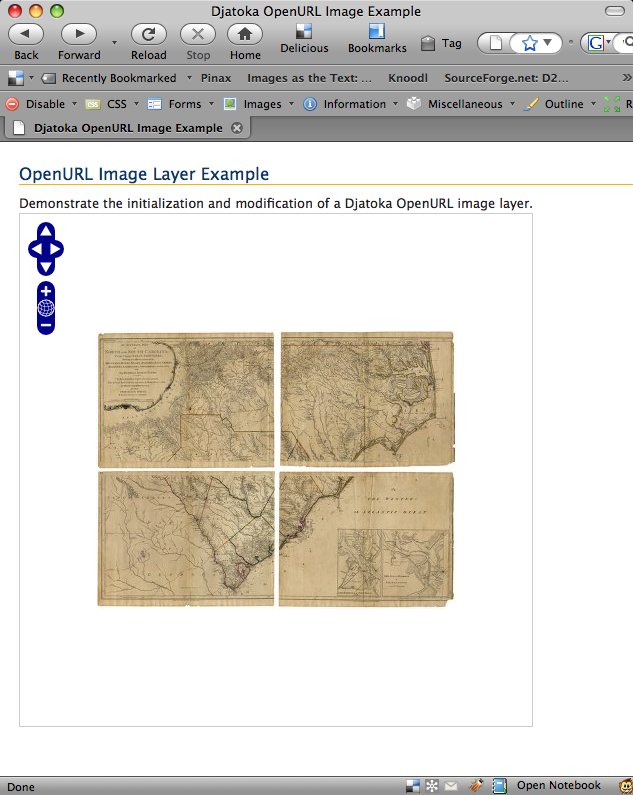
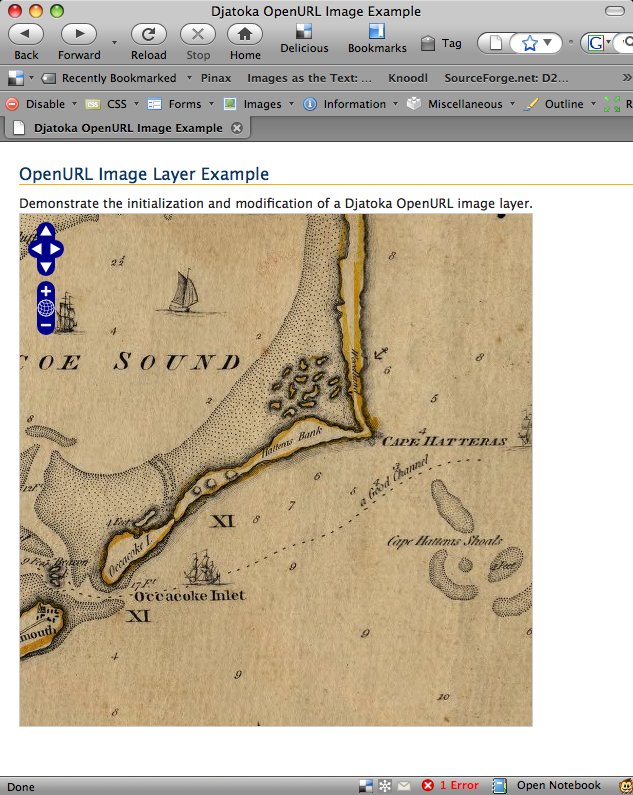
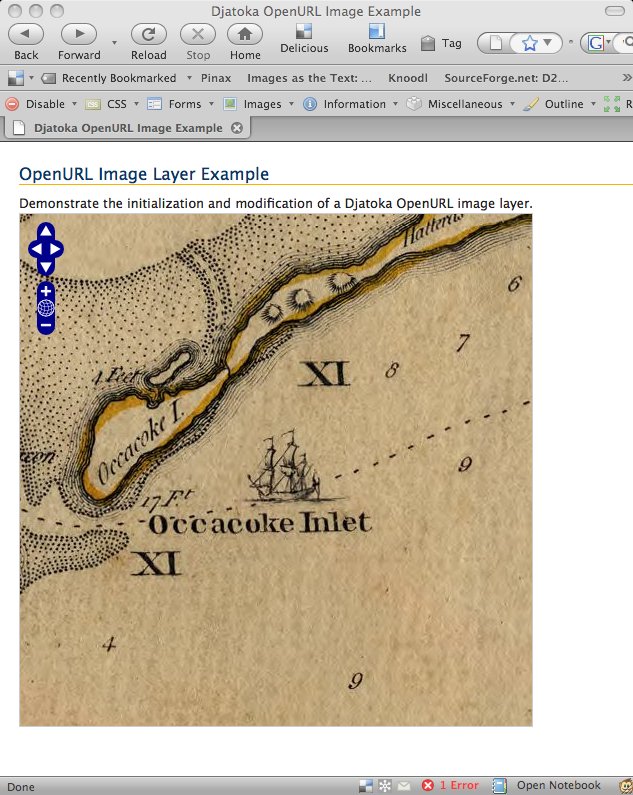
For the last few weeks, I've been playing around with the new JPEG2000 image server released by the Los Alamos National Labs (http://african.lanl.gov/aDORe/projects/djatoka/). I never could get the image viewer released along with it to work, and I immediately thought of OpenLayers (http://openlayers.org/), a javascript API for embedding maps. OpenLayers is like Google Maps in many ways, but Free. Besides maps, it works very well for any image, and provides a lot of tools developed for mapping, but also useful for displaying and working with any large image. I wanted to use OpenLayers support for tiled images in conjunction with Djatoka's ability to render arbitrary sections of an image at a number of zoom levels (the number of levels available depends on how the image was compressed).

After a lot of messing around and some false starts, I've developed a Javascript class that supports Djatoka's OpenURL API. I've been testing it on JPEG2000 images created with ContentDM in the UNC Library's digital collections, with a good deal of success. The results are not yet available online, because I don't have a public-facing server I can host it on, but the source code is up on github here.

Instructions:

Install Djatoka. Incidentally, in order to get this in the queue for installation on our systems, I had to make Djatoka work on Tomcat 6. The binary doesn't work out of the box, but when I rebuilt it on my system (RHEL 5), it worked fine.

Copy the adore-djatoka WAR into your Tomcat webapps directory. Follow the instructions on the Djatoka site to start the webapp.

Grab a copy of OpenLayers. Put the OpenURL.js file in lib/OpenLayers/Layer/ and run the build.py script.

To just run the demo, copy the djatoka.html, the OpenLayers.js you just built, and the .css files from OpenLayers/theme/ and from the examples/ directory, as well as the OpenLayers control images from OpenLayers/img into the adore-djatoka directory in webapps. You should then be able to access the djatoka.html file and see the demo.

This all comes with no guarantees, of course. It seems to work quite well with the JPEG2000 images I've tested, and the tiling means that each request of Djatoka consumes an equal amount of resources. I've run into OutOfMemoryErrors when requesting full-size images, but this method loads them without any problem.

Update (2009-01-05 14:37): I've posted a fix to the OpenURL.js script for a bug pointed out to me by John Fereira on the djatoka-devel list. If you grabbed a copy before now, you should update.

Update: screenshots --


Wednesday, October 29, 2008

Thoughts on crosswalking

For the second Integrating Digital Papyrology project, we need to develop a method for crosswalking between EpiDoc (which is a dialect of TEI) and various database formats. We've thought about this quite a bit in the past and we think that we don't just want to write a one-off conversion because (a) there will be more than one such conversion and (b) we want to be able to document the mappings between data sources in a stable format that isn't just code (script, XSLT, etc.)

Some of the requirements for this notional tool are:


  • should document mappings between data formats in a declarative fashion

  • certain fields will require complex transformations. For example, the document text will likely be encoded in some variant of Leiden in the database, and will need to be converted to EpiDoc XML. This is currently accomplished by a fairly complex Python script, so it should be possible to define categories of transformation which would signal a call to an external process.

  • some mappings will involve the combination of database fields into a single EpiDoc element, and others, the division of a single field into multiple EpiDoc elements

  • Context-specific information (not included in the database) will need to be inserted into the EpiDoc document, so some sort of templating mechanism should be supported.

  • The mapping should be bidirectional. We aren't just talking about exporting from a database to EpiDoc, but also about importing from EpiDoc, which is envisioned as an interchange format as well as a publication format. This is why a single mapping document, rather than a set of instructions on how to get from one to the other would be nice.


So far, my questions to various lists have turned up favorable responses (i.e. "yes, that would be a good thing") but no existing standards....

Monday, October 20, 2008

On Bamboo the 2nd

I spent Thursday - Saturday last week at the second Bamboo workshop in San Francisco. So some reactions:

1) The organizers are well-intentioned and are sincerely trying to wrestle with the problem of cyberinfrastructure for Digital Humanities.

2) That said, it isn't clear that the Bamboo approach is workable. The team is very IT focused, and while they seem to have a solid grasp of large-scale software architecture, the ways in which that might be applied to the Humanities with any success aren't obvious. There was a lot of misdirected effort between B1 and B2 by some very smart people, who I must say had the good grace to admit it was a nonstarter. Their attempt to factor the practices of scholars into implementable activities resulted in something that lacked enough context and specificity to be useful. A refocusing on context and on the processes that contain and help define the activities happened at the workshop and seems likely to go forward.

3) The workshops themselves seem to have been quite useful. I wasn't at any or the round one workshops, and I doubt I'll be at any of the others (I represented the UNC Library because the usual candidates weren't available), but everyone I talked to was very engaged (if often skeptical). The connections and discussion that seem to have emerged so far probably make the investment worthwhile, even if "Bamboo" as conceived doesn't work.

4) The best idea I heard came (not surprisingly) from Martin Mueller, who suggested Bamboo become a way to focus Mellon funding on projects that conform to certain criteria (such as reusable components and standards) for a defined period (say five years). The actual outcome of the current Bamboo would be the criteria for the RFP. Simple, encourages institutions to think along the right lines, might actually do some good, and might allow participation by smaller groups as well.

5) There was a lot of talk about the people who are both researchers and technologists (guilty). These were variously defined as "hybrids," "translators," and, most offensively, "the white stuff inside the Oreo." None of this was meant to be offensive, but in the end, it is. People who can operate comfortably in both the worlds of scholarship and IT can certainly be useful go-betweens for those who can't, but that is not our sole raison d'être. Until recently there haven't been many jobs for us, but that seems to be changing, and I hope it continues to. See Lisa Spiro's excellent recent post on Digital Humanities Jobs and Sean Gillies, who without having been there, manages to capture some of the reservations I feel about the current enterprise and pick up on the educational aspect. One possible useful future for Bamboo would be simply to foster the development of more "hybrids."

6) The Bamboo folks have set themselves a truly difficult task. They are making a real effort to tackle it in an open way, and should be commended for it. But it is a very hard problem, and one for which there is still not a clear definition. The software engineer part of my hybrid brain wants problems defined before it will even consider solutions. The classicist part believes some things are just hard, and you can't expect technology to make them easy for you.

Sunday, September 28, 2008

Go Zotero!

The Thomson Reuters lawsuit against the developers of Zotero is getting a lot of notice, which is good.

I've noticed that in the library world, when people mention getting sued, it's with fear and the implication that this represents the end of the world. It's an interesting contrast coming from working for a startup (albeit a pretty well-funded one) where lawsuits == a) publicity, and are not to be feared (perhaps even to be provoked) and/or b) are a signal that you've scared your competitors enough to make them go running to Daddy, thus unequivocally validating your business model.

This is an act of sheer desperation on the part of Thomson Reuters. They're hoping GMU will crumble and shut the project down. I do hope Dan has contacted the EFF (donate!) and that the GMU administration will take this for what it is: fantastic publicity for one of their most important departments and an indicator that they are doing something truly great.

Friday, August 15, 2008

Back from Balisage

I never made it to Extreme, Balisage's predecessor, despite wanting to very badly, so I'm very glad I did go to its new incarnation. I'm still processing the week's very rich diet of information, but it was very, very cool.

Simon St. Laurent, who wrote one of the first XML books I bought back in 1999, Inside XML DTDs has a photo of one of the slides from my presentation in his Balisage roundup post. This is the kind of κλέος I can appreciate!

Thursday, August 14, 2008

Balisage Presentation online

I just rsynced up my presentation on linking manuscript images to transcriptions using SVG for Balisage, that I gave this morning. It's at http://www.unc.edu/~hcayless/img2xml/presentation.html. The image viewer embedded into the presentation is at http://www.unc.edu/~hcayless/img2xml/viewer.html. Text paths are still busted at the highest resolution, as you'll see if you zoom all the way in, but apart from that it seems to work.

Balisage has been a really great conference so far. I highly recommend it.

Saturday, May 31, 2008

New TransCoder release

This is something I've been meaning to wrap up and write up for a while now: thanks to the Duke Integrating Digital Papyrology grant from the Andrew W. Mellon Foundation, I've been able to make a bunch of updates to the Transcoder, a piece of software I originally wrote for the EpiDoc project. Transcoder is a Java program that handles switching the encodings of Greek text, for example from Beta Code to Unicode (or back again). It's used in initiatives like Perseus and Demos. I've been modifying it to work with Duke Databank of Documentary Papyri XML files (which are TEI based). Besides a variety of bug fixes, there is now also included in Transcoder a fully-functional SAX ContentHandler that allows the processing of XML files containing Greek text to be transcoded.

There are a lot of complex edge cases in this sort of work. For example, Beta Code (or at least the DDbDP's Beta) doesn't distinguish between medial (σ) and final (ς) sigmas. That's an easy conversion in the abstract (just look for 's' at the end of a word, and it's final), but when your text is embedded in XML, and there may be an expansion (<expan>) tag in the middle of a word, for example, it becomes a lot harder. You can't just convert the contents of a particular element--you have to be able to look ahead. The problem with SAX, of course, is that it's stream-based, so no lookahead is possible unless you do some buffering. In the end what I did was buffer SAX events when an element (say a paragraph) marked as Greek begins, and keep track of all the text therein. That let me do the lookahead I needed to do, since I have a buffer containing the whole textual content of the <p> tag. When the end of the element comes, I then flush the buffer, and all the queued-up SAX events fire, with the transcoded text in them.

That's a lot of work for one letter, but I'm happy to say that it functions well now, and is being used to process the whole DDbDP. Another edge case that I chose not to solve in the Transcoder program is the problem of apparatus and their contents in TEI. An <app> element can contain a <lem> (lemma) and one or more <rdg> (readings). The problem with it is that the lemma and readings are conceptually parallel in the text. For example:

The quick brown <lem>fox</lem> jumped over the lazy dog.
                <rdg>cat</rdg>


The TEI would be:

The quick brown <app><lem>fox</lem><rdg>cat</rdg></app> jumped over the lazy dog

So "cat" follows immediately after "fox" in the text stream, but both words occupy the same space as far as the markup is concerned. In other words, I couldn't rely only on my fancy new lookahead scheme, because it broke down in edge cases like this. The solution I went with is dumb, but effective: format the apparatus so that there is a newline after the lemma (and the reading, if there are multiple readings). That way my code will still be able to figure out what's going on. The whitespace so introduced really needs to be flagged as significant, so that it doesn't get clobbered by other XML processes though. That has already happened to us once. It caused a bug for me too, because I wasn't buffering ignorable whitespace.

All that trouble over one little letter. Lunate sigmas would have made life so much easier...

Sunday, March 16, 2008

D·M·S· Allen Ross Scaife 1960-2008

On Saturday afternoon, March 15th, I learned that my friend Ross had died that morning after a long and hard-fought struggle with cancer. He was at his home in Lexington, Kentucky, surrounded by his family.

Ross was one of the giants of the Digital Classics community. He was the guiding force behind the Stoa, and the founder of many of its projects. Ross was always generous with his time and resources and has been responsible for incubating many fledgling Digital Humanities initiatives. His loss leaves a gap that will be impossible to fill.

Ross was also a good friend, easy to talk to, and always ready to encourage me to experiment with new ideas. I miss him very much.

What he began will continue without him, and though we cannot ever replace Ross, we can honour his memory by carrying on his good work.

update (March 21, 21:04)

Dot posted a lovely obituary of Ross at the Stoa. Tom and several others have posted nice memorials as well.

On a happier note: my daughter, Caroline Emma Ross Cayless was born at 11:52 pm, March 19th.

Wednesday, January 23, 2008

Catching up

My New Year's resolution was to write more, and specifically to blog more, but so far all of my writing has been internally focussed at my job.  So I shall have another go...

Speaking of New Year's, I spent a chunk of New Year's Eve getting The Colonial and State Records of North Carolina off the ground.  It's driven by the eXist XML database, of which I've grown rather fond.  XQuery has a lot of promise as a tool for digital humanists with large collections of XML.